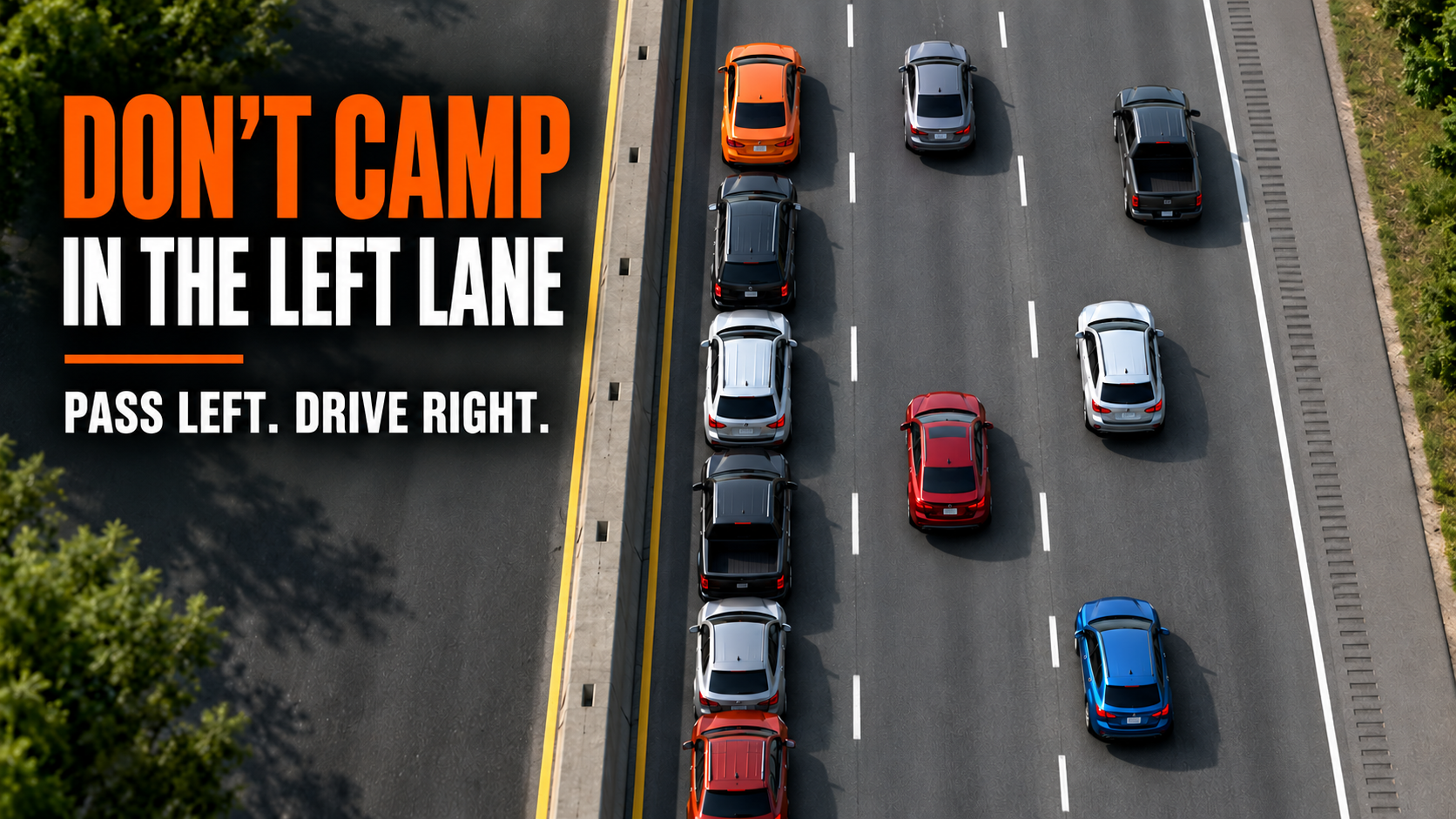
Most drivers have encountered it: a vehicle stays in the left lane for miles while traffic begins stacking up behind it. This is commonly called “left-lane camping.”
It may seem like a minor inconvenience, but improper use of the left lane can create congestion, encourage aggressive driving, and increase the number of risky maneuvers happening around the slower vehicle.
What Is the Left Lane?
On a highway with two or more lanes traveling in the same direction, the left lane is generally the lane farthest from the right shoulder. It is often called the “fast lane,” but “passing lane” is a more accurate description.
The left lane is normally used to:
- Pass a slower-moving vehicle
- Prepare for a left-side exit
- Avoid an obstruction or closed lane
- Give space to emergency responders, road crews, tow trucks, or disabled vehicles
- Follow temporary traffic-control directions in a work zone
Once a driver completes a pass, the safest practice is to return to the right when there is enough room to do so.
The exact law varies by state. Some states reserve the left lane primarily for passing, while others require slower vehicles to keep right or require drivers to move over when another vehicle is attempting to pass.
Why Is Left-Lane Camping Dangerous?
It creates differences in traffic speed
A vehicle traveling significantly slower than surrounding traffic forces approaching drivers to brake. That disturbance can travel backward through traffic and create a sudden slowdown even when there is no crash, construction project, or other visible obstruction.
Research reviewed by the Federal Highway Administration found that crash likelihood can increase as speed differences, traffic density, and weaving increase.
It encourages passing on the right
When the passing lane is blocked, impatient drivers often move across multiple lanes to get around the slower vehicle. Passing on the right may place them near vehicles entering and exiting the highway, where drivers are already merging and changing speeds.
More lane changes mean more opportunities for blind-spot conflicts, sideswipe crashes, and sudden braking.
It can lead to tailgating and aggressive driving
Left-lane camping does not excuse speeding, tailgating, or aggressive behavior. Every driver is responsible for making safe decisions.
However, blocking the passing lane can cause frustration to build. The Connecticut State Police warns that left-lane misuse contributes to tailgating, weaving, and aggressive driving that can quickly lead to serious crashes.
If another driver is following too closely, do not brake-check them or attempt to control their speed. Maintain a safe speed and move right when it is safe.
It reduces the road’s ability to carry traffic
A multi-lane highway works best when drivers use each lane predictably. When two vehicles travel next to each other at approximately the same speed, traffic can build behind them and reduce the available space for passing, merging, and responding to changing road conditions.
That becomes especially dangerous near work zones, lane closures, crashes, and emergency scenes, where drivers may need to merge with little notice.
What Are States and Law Enforcement Doing?
Transportation departments and law-enforcement agencies across the country are combining education, highway messaging, new signs, and traffic enforcement to improve lane discipline.
In the Northeast, the Connecticut Department of Transportation launched its statewide “Pass Left. Drive Right.” campaign. The campaign uses television advertisements and public-safety messaging to explain that drivers should pass on the left and then return to the right. Beginning October 1, 2026, strengthened enforcement provisions allow violators to face an $88 fine.
In the Mountain West, the Colorado State Patrol has issued public warnings explaining that drivers can be stopped for remaining in the left lane when they are not passing. Troopers emphasize that driving at the posted speed limit does not automatically make it appropriate to remain in the passing lane.
In the South, the Texas Department of Public Safety regularly includes left-lane education in its increased holiday-enforcement campaigns. During its 2026 Labor Day enforcement announcement, Texas DPS reminded drivers that slower traffic must keep right and that posted left lanes are for passing.
The Florida Department of Highway Safety and Motor Vehicles also tells drivers not to remain in the far-left lane when they are being overtaken by a faster vehicle, except in circumstances such as preparing for a left turn.
In the Midwest, the Illinois State Police includes proper left-lane behavior in its guidance for preventing road rage. Drivers are advised to move right and allow another vehicle to pass instead of escalating the situation.
These efforts share one message: the left lane should be used purposefully, not as a permanent travel lane.
Following the Rule Does Not Mean Speeding
Keeping right does not give anyone permission to exceed the speed limit. Speed limits still apply in every lane.
The proper approach is simple:
- Check your mirrors and blind spot.
- Signal before changing lanes.
- Move left only when there is enough space to pass safely.
- Complete the pass without exceeding the posted speed limit.
- Return to the right when you can do so safely.
Drivers should also follow all posted lane-use signs. Construction zones, emergency scenes, traffic incidents, and left-side exits may temporarily require different lane positioning.
Safer Roads Depend on Predictable Driving
Good lane discipline is about more than courtesy. It helps traffic move predictably and reduces unnecessary braking, weaving, and conflict between drivers.
The next time you use the left lane, remember the simplest version of the rule:
Pass on the left. Drive on the right. Stay patient and give everyone room.
At American Signal Company, we believe safer roads begin with clear communication and responsible decisions. Whether approaching a work zone, passing another vehicle, or responding to an unexpected traffic condition, staying alert can help prevent the next crash.